
Report: Cybercriminals Launching More Intricate, Targeted Attacks
10-30-2019

Despite the high-profile takedown of Altenen—a major hacker hub—in May 2018, the financial services sector and related industries continue to face a daunting threat landscape, according to two new reports.
IntSights’ recently released “Banking & Financial Services Cyberthreat Landscape Report” identified significant fallout from the January 2019 megabreach known as “Collections #1-5,” in which roughly 2.2 billion records of login credentials and personal information from around the world were leaked to hackers. Those breaches were largely responsible for a 129 percent year-over-year increase in leaked credentials.
Among other key findings was a 212 percent year-over-year increase in instances of compromised credit cards, which were primarily used to make small purchases to reduce the risk of being detected. The report also identified a 102 percent year-over-year increase in malicious applications, such as fraudulent mobile banking apps that imitate major blue-chip banking apps. That type of malicious application is particularly concerning because more than one-third of consumers are fooled by fraudulent banking apps, according to IntSights.
The reports also found that cybercriminals are honing and expanding their attacking methods. The IntSights report found that banking and financial services organizations were targeted in 26 percent of all malware attacks in 2018, more than any of the other 27 industries studied. Ransomware also continued to pose a significant threat, enabling criminals to execute costly denials of service, such as the February 2019 incident at a bank in Mexico.
Similarly, Accenture identified “big game hunting,” or threat actors and groups targeting institutions for financial gain, as a trend in its recently published “2019 Cyber Threatscape Report.” More cybercriminals also are sharing tools that automate the process of mass-producing malicious documents to spread malware, according to the report.
In addition to sending malware to internet users via phishing emails, some cybercriminals are now executing malware attacks executed through web browsers and targeting online merchants and retailers. And threats are expanding throughout the supply chain. “The global interconnectedness of business, the wider adoption of traditional industry cyberthreat countermeasures, and improvements to basic cybersecurity hygiene appear to be pushing cyberthreat actors to seek new avenues to compromise organizations, such as targeting their supply chains—including those for software, hardware, and the cloud,” Accenture noted.
This article originally appeared in the Fall 2019 edition of Transaction Trends magazine. Click here to read the full issue.
Interested in cybersecurity? Check out the Electronic Transactions Association’s cybersecurity resource page here.
About ETA
The Electronic Transactions Association (ETA) is the world’s leading advocacy and trade association for the payments industry. Our members span the breadth of significant payments and fintech companies, from the largest incumbent players to the emerging disruptors in the U.S. and in more than a dozen countries around the world. ETA members make commerce possible by processing approximately $56.75 trillion annually in purchases and P2P payments worldwide and deploying payments innovation to merchants and consumers.
ETAs membership spans the breadth of the payments industry to include independent sales organizations (ISOs), payments networks, financial institutions, transaction processors, mobile payments products and services, payments technologies, and software providers (ISV) and hardware suppliers. For more information, visit electran.org.
Related Posts
News
Is the Relationship Between Financial Institutions (FIs) And Fintechs Complicated? Not Anymore.
By Sumit Arora, Senior Vice President, Enterprise Payments Strategy, Wells Fargo Building a Balance Between Competition and Collaboration There is a long history between banking and technology, dating back to around 1866 when the telegraph . . .
6-16-2022
learn more
News
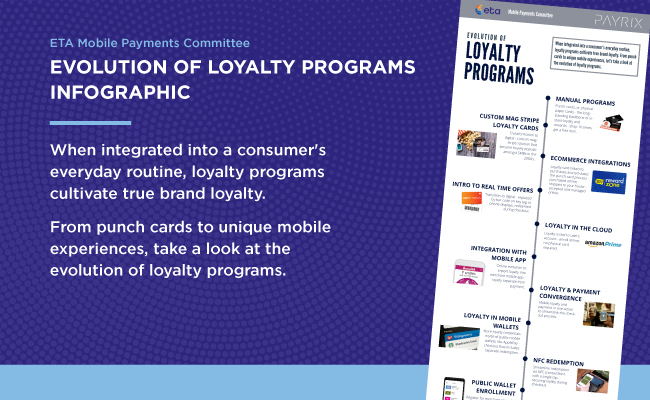
INFOGRAPHIC: Tracking the Evolution of Loyalty Solutions
Loyalty programs cultivate lifelong customers. And they’ve come a long way since the days of punch cards. Modern loyalty solutions integrated mobile payments, rewards and ecommerce technology to get customers to keep coming back. For . . .
5-20-2021
learn more